- Studio
- Merkur
- Game type
- Slots
- Released
- Sep 2016
- Themes
- Egyptian
- Reviewed by
- Liam Bennett
- Updated
- 15 Sep 2026
Game details
Eye of Horus · free demo · virtual coins only · 18+
SlotsRanker is a free social casino for an adult audience (18+). The games do not offer real money gambling or an opportunity to win real money or prizes. Practice or success at social casino gaming does not imply future success at real money gambling.
The numbers
RTP96.31%
VolatilityMedium
Max win—
Layout5x3
Paylines10 paylines (Merkur build: playable on 5 or 10 lines)
Release date7 Sep 2016
Features
Expanding wildSymbol upgradesExtra free spins
A dash (—) means the studio has not published that figure. We never estimate it.
Specs checked against the studio’s published game information · View source
The studio also supplies this game with lower RTP settings: 94.83%, 92.44%, 90.25%, 88.26%. The version you play may use one of these; check the in-game rules.
In this review
- Quick verdict: a ten-line classic built around one wild
- Eye of Horus spec table
- Which Eye of Horus the rules here describe
- The upgrade ladder: how free games get richer as they go
- Horus on reels 2, 3 and 4 in the base game
- Reading the paytable and what it can't tell you
- Max win: why no single figure is quoted here
- RTP 96.31% and the four lower settings
- The gamble options some builds list
- How the classic compares with its Blueprint spin-offs
- Who Eye of Horus suits
- Where Eye of Horus works and where it doesn't
- Eye of Horus FAQ
Quick verdict: a ten-line classic built around one wild
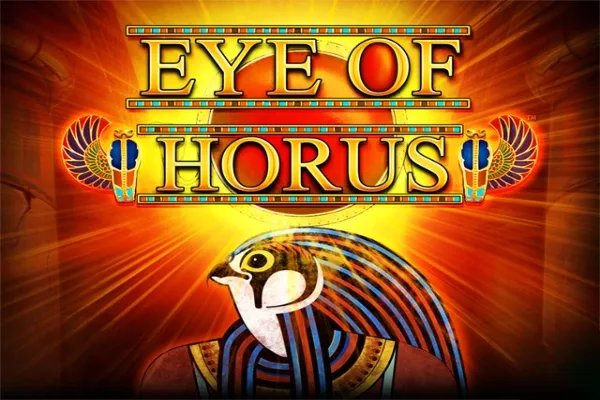
Eye of Horus is a 5x3, 10-payline slot that became a fixture of German arcade machines before moving online. The Merkur-listed online version, originally developed by Reel Time Gaming, has an RTP of 96.31% and is rated Medium volatility. It launched on 7 September 2016. The whole game runs on one symbol: Horus, a wild that expands to fill its reel. In free games, each Horus also upgrades a picture symbol for the rest of the round.
That upgrade is what makes the game worth studying. The base game is simple, with expanding wilds on three reels and a small paytable. The feature slowly strips the lower pictures off the reels until, in a long round, only the top symbol remains among the pictures. The maximum win has not been confirmed by the studio, and there are lower RTP builds, so check which version you're looking at.
Eye of Horus spec table
| Spec | Detail |
|---|---|
| Version reviewed | Merkur-listed online version (originally Reel Time Gaming) |
| Release date | 7 September 2016 |
| Grid | 5 reels x 3 rows |
| Paylines | 10, left to right |
| RTP | 96.31% (other versions: 94.83%, 92.44%, 90.25%, 88.26%) |
| Volatility | Medium |
| Max win | — (50,000x is quoted, possibly per line) |
| Wild | Horus, expands to fill reels 2, 3 and 4 |
| Scatter | 3 or more trigger 12 free games |
| Free games extras | Each Horus upgrades a picture symbol and adds free games |
| Bonus buy | None listed |
Which Eye of Horus the rules here describe
The name covers several games, and they don't share one set of rules. It helps to be clear before going further.
- The Merkur land-based machine. Merkur's own article describes the arcade version, which can be played on five or ten lines with a range of stake levels. That's a machine product, not the online game reviewed here.
- The Merkur-listed online version. This is the Reel Time Gaming build distributed as Merkur, released 7 September 2016, at 96.31% RTP. This review covers this version.
- Blueprint builds. Blueprint Gaming publishes Eye of Horus for UK markets. Its B3/Cat C product page describes the same core rules: expanding wild, 12 free games from three or more PYRAMIDS, and upgrades in the feature. Stake limits and RTP can differ between these builds and the online version.
- Spin-offs. Blueprint has built many follow-ups on the name, including Megaways, Gold Spins Megaways and Tablets of Destiny Megaways. They're separate games with their own specs, compared near the end.
Small details such as the scatter's name or the exact number of extra free games can vary between builds. Where that happens, we note it in a line and point you to the in-game help screen, which always describes the build in front of you.
The upgrade ladder: how free games get richer as they go
The trigger
Three, four or five scatters on the reels start the feature, according to Merkur's article. The scatter's name depends on the build: Merkur calls it the Temple of Horus, and Blueprint's rules say PYRAMIDS. Either way, the award is 12 free games. The scatter is also commonly listed with its own pay, 500x for five, though it isn't clear whether that figure is measured against the line bet or the total bet.
What happens when Horus lands
Blueprint's rules list three things that happen each time Horus appears during the feature:
- It expands to fill the reel and substitutes for all symbols.
- It adds free games.
- It upgrades a picture symbol.
All three happen together. A wild that lands on a quiet spin with no winning line still upgrades a symbol and adds spins. In the free games, Horus is never wasted.
The ladder itself
Merkur's description is the clearest: symbols are upgraded one step at a time, "starting with the lowest value (e.g. the fan)", and moving up to the next level. Each upgrade removes the lowest remaining picture from the reels and replaces it with the next one up. Carried far enough, the wilds keep upgrading until every picture on the reels is the Eye of Horus.
Using the commonly listed picture symbol values, from lowest to highest, the ladder runs:
| Step | Picture symbol | Listed pay for 5 |
|---|---|---|
| Lowest | Fan | 200x |
| Ankh | 200x | |
| Scarab | 250x | |
| Horus falcon | 300x | |
| Anubis shrine | 400x | |
| Top | Eye of Horus | 500x |
Symbol names shift a little between builds. The fan is sometimes called a flower, and the falcon an eagle or bird. The direction of the ladder is the same across builds, though: from the fan toward the Eye of Horus. Blueprint's rules say picture symbols are upgraded. Nothing in the studio material says the A, K, Q and J card symbols are upgraded, so we don't claim it.
There are six picture symbols, so five upgrades turn every picture into the Eye of Horus. After that point, every picture that lands is the top symbol, and only the card royals, wilds and scatters vary.
It's worth pausing on what one upgrade is worth. Moving the fan up to the ankh changes nothing in listed value, since both pay 200x for five. Moving the ankh to the scarab adds 50x at the five-symbol level. The later steps add more: the shrine is worth 100x more than the falcon, and the Eye of Horus 100x more than the shrine. So the first upgrade in a round mostly thins the reel set without changing values, and the later ones are where each step adds visible weight. The bigger effect is concentration. With fewer distinct pictures on the reels, the ones that remain land together on the same line far more often.
Why three wilds per spin caps the pace
Horus lands only on reels 2, 3 and 4, so at most three wilds can appear on one spin. That limits two things at once:
- Upgrades per spin: at most three.
- Extra free games per spin: 1 for one wild, 3 for two wilds, 5 for three wilds, per Blueprint's rules summary. Some builds may use a slightly different scale for three wilds, so check the help screen.
Reaching a fully upgraded reel set takes at least two spins with wilds, because five upgrades are needed and no spin can supply more than three. The retrigger scale works in the player's favour here. Two wilds on one spin add three free games, not two, and three wilds add five. The spins that do the most upgrading also add the most time for those upgrades to pay. Extra free games are widely reported to have no upper limit.
Because upgrades build over the round, the order matters. A Horus landing on spin 2 changes the reels for the next 10 or more spins. A Horus on the last spin upgrades a symbol that only has that spin to pay, unless the added free games extend the round.
A simple way to picture a round: think of it as two phases. In the first phase, wilds are doing their main job, which is climbing the ladder and adding spins. Each wild spin makes every later spin a little richer. In the second phase, once most or all of the ladder is climbed, wilds shift to their other job, which is completing lines of the now-dominant top symbol across all ten lines. A round that climbs quickly spends most of its length in the second phase. A round where wilds arrive late never really gets there.
Horus on reels 2, 3 and 4 in the base game
Away from the feature, Eye of Horus is ten lines and one expanding wild. Wins pay left to right on the 10 fixed lines. The Horus wild can land on reels 2, 3 and 4 only. When it lands, it expands to cover all three positions on its reel and substitutes for every symbol except the scatter.
An expanded wild on reel 2, 3 or 4 is on every one of the 10 lines at once, because every line passes through each reel. So a single Horus effectively becomes a full column of wilds for all ten lines. That makes it more valuable than its landing rate suggests.
Two or three expanded wilds on the same spin make the grid much more forgiving. With reels 2, 3 and 4 all wild, any line only needs matching symbols on reel 1 (plus reel 5 for a five-of-a-kind) to pay. The base game has no upgrade ladder, though, so those wins use the normal paytable.
Since wins run left to right, reel 1 is the gatekeeper in every case. Horus never lands there, so a line always needs a real symbol on reel 1 to start. That's why the wild placement matters: by sitting in the middle three reels, Horus can only extend lines that reel 1 has already opened, never create one on its own. Reel 5 works the other way. It's the only reel that separates a four-of-a-kind from a five-of-a-kind, and it can't hold a wild either.
The base game is built to be plain. With only one modifier, the free games carry a large share of the game's value. That split is typical of a classic ten-line design with one feature.
Reading the paytable and what it can't tell you
The commonly listed values for five of a kind are:
- Eye of Horus: 500x
- Anubis shrine: 400x
- Horus falcon: 300x
- Scarab: 250x
- Ankh and fan: 200x each
- A, K, Q and J: 100x each
- Scatter: 500x for five
These published figures don't say whether they are multiples of the line bet or the total bet, or what three- and four-of-a-kind pay. The difference matters: on 10 lines, 500x the line bet equals 50x the total bet. We quote the figures as listed rather than guess at the unit.
Here's how to read the in-game paytable for the build you're playing. First, check the unit. If values are shown as coin amounts that change when you change the stake, they are tied to your bet level, and dividing by the line stake tells you the line-bet multiple. Second, look at the three-symbol row for each picture, which shows how much the common small wins are worth. Third, check the wild's own row, if it has one, and whether the scatter pays against the total bet. Finally, open the free games page and confirm the extra-spins scale and the upgrade order. Those four checks tell you everything the listed figures above leave out.
Max win: why no single figure is quoted here
Published max-win figures for this game vary (50,000x and 20,000x both appear, and it isn't always clear whether 50,000x refers to the line bet or the total bet), and the studio hasn't confirmed one, so we treat it as not verified.
The arithmetic shows why the unit matters. With 10 lines, 50,000x the line bet would be 5,000x the total bet, a tenth of the total-bet reading. The listed symbol values don't settle it either. If every line showed five Eyes of Horus at 500x each, that's 5,000x the line bet across ten lines, which is well below either 50,000x reading unless a separate wild or scatter pay adds to it. Until the studio's paytable for a specific build confirms it, no single figure should be treated as the answer.
What's clear is how the top results are reached: a long free games round in which enough wilds land early to climb the whole ladder, followed by spins where expanded wilds and all-Eye-of-Horus reels line up across all ten lines.
RTP 96.31% and the four lower settings
Eye of Horus comes in five RTP versions: 96.31%, 94.83%, 92.44%, 90.25% and 88.26%. The spread from top to bottom is just over eight percentage points, which is wide. At 96.31%, the design returns 96.31 coins per 100 wagered over a very long run. At 88.26%, it returns 88.26. That gap doesn't show in a short session, but it is a big difference in long-run design.
UK builds from Blueprint can carry their own RTP figures outside this list. The help screen is the only reliable guide to which version is running.
The volatility rating is Medium, though the game is sometimes described as medium-high. The structure explains why opinions differ. The base game has only one modifier and a modest paytable. The upgrade ladder, meanwhile, can turn a free games round into a very different kind of result. Results cluster around ordinary base spins, with a long tail from rounds that climb the ladder quickly.
In practical terms, Medium here means the base game supplies modest line wins, with the free games as the main source of larger results. It does not mean results are smooth. A single round that climbs the ladder early can outweigh a long run of base spins. RTP and volatility describe the design over a very large number of spins, and neither tells you when a feature will arrive. No spin is ever due.
The gamble options some builds list
Some builds and markets add an optional gamble after a win, usually a card guess (red or black to double) or a risk ladder. Neither Merkur's rules article nor Blueprint's product page mentions a gamble feature, so whether it appears depends on the build. Where it exists, it's optional. A red or black guess is a coin flip, not a skill, and it doesn't improve the game's long-run return.
How the classic compares with its Blueprint spin-offs
The original is widely remembered as a simple classic, especially popular in Germany, which Blueprint then reworked for its Megaways range. The spin-offs keep the Horus theme and upgrade idea but change the grid:
| Eye of Horus (reviewed) | Eye of Horus Megaways | Eye of Horus Gold Spins Megaways | |
|---|---|---|---|
| Grid | 5x3 | 6 reels, up to 5 symbols each | 6 reels |
| Ways/lines | 10 lines | Up to 15,625 ways | Up to 15,625 ways |
| RTP (widely reported) | 96.31% (plus lower versions) | 95.02% | 94% / 93% / 92% / 90% |
| Max win (widely reported) | — | 10,000x | 10,100x |
| Release | 7 September 2016 | 5 October 2019 | Not stated |
Blueprint has also released Eye of Horus Tablets of Destiny Megaways (widely reported at a 10,000x max win, with free spins symbol upgrades) and Eye of Horus The Golden Tablet, among other follow-ups.
The key difference is that the original is fixed and readable. Ten lines, three wild reels, one ladder. The Megaways versions add changing reel heights and thousands of ways, which makes results harder to track. The original's top RTP is higher than the Megaways figures above, but it comes in several versions, so that advantage depends on the build.
Who Eye of Horus suits
- Players who like classic 5x3 ten-line slots and don't want grids or modifiers to learn.
- Anyone who enjoys features that build over a round, where early wilds shape everything that follows.
- Players who want medium volatility rather than the extreme swings of high-cap modern games.
It's a poorer fit if you want many bonus types, a clearly documented max win, or a bonus buy, which isn't listed for this version.
Where Eye of Horus works and where it doesn't
Pros
- Every Horus in free games does three jobs at once: expands, adds spins, upgrades a symbol.
- The upgrade ladder gives long rounds a clear, growing value.
- An expanded wild on reels 2–4 covers all ten lines at once.
- The top RTP version, 96.31%, is solid for the format.
Cons
- Five RTP versions go as low as 88.26%, and UK builds may show other figures.
- The max win isn't confirmed by the studio.
- The base game has a plain structure with just one modifier.
Eye of Horus FAQ
Who made Eye of Horus?
The online version reviewed here was originally developed by Reel Time Gaming and is listed under Merkur. Blueprint Gaming publishes builds for UK markets and has made several spin-offs.
What is the RTP of Eye of Horus?
The top version is 96.31%. Lower versions run at 94.83%, 92.44%, 90.25% and 88.26%. The help screen shows the one you're playing.
Which reels can the Horus wild land on?
Reels 2, 3 and 4. It expands to cover the full reel and substitutes for everything except the scatter.
How do free games start?
Three or more scatters trigger 12 free games. Merkur calls the scatter the Temple of Horus; Blueprint's rules call it the pyramid.
How does the symbol upgrade work?
Each Horus in free games upgrades one picture symbol, starting with the lowest-value picture (the fan) and moving up. After enough upgrades, all picture symbols become the Eye of Horus for the rest of the round.
How many extra free games do wilds add?
One, two or three wilds on a spin add 1, 3 or 5 free games according to Blueprint's rules summary. The help screen confirms the scale for your build.
What is the max win?
Not verified. Different figures are quoted, and the studio hasn't confirmed one.
Is Eye of Horus high volatility?
It is rated Medium, though some describe it as medium-high because of how much the free games can add.
Sources we checked
Rate this game
Games like Eye of Horus