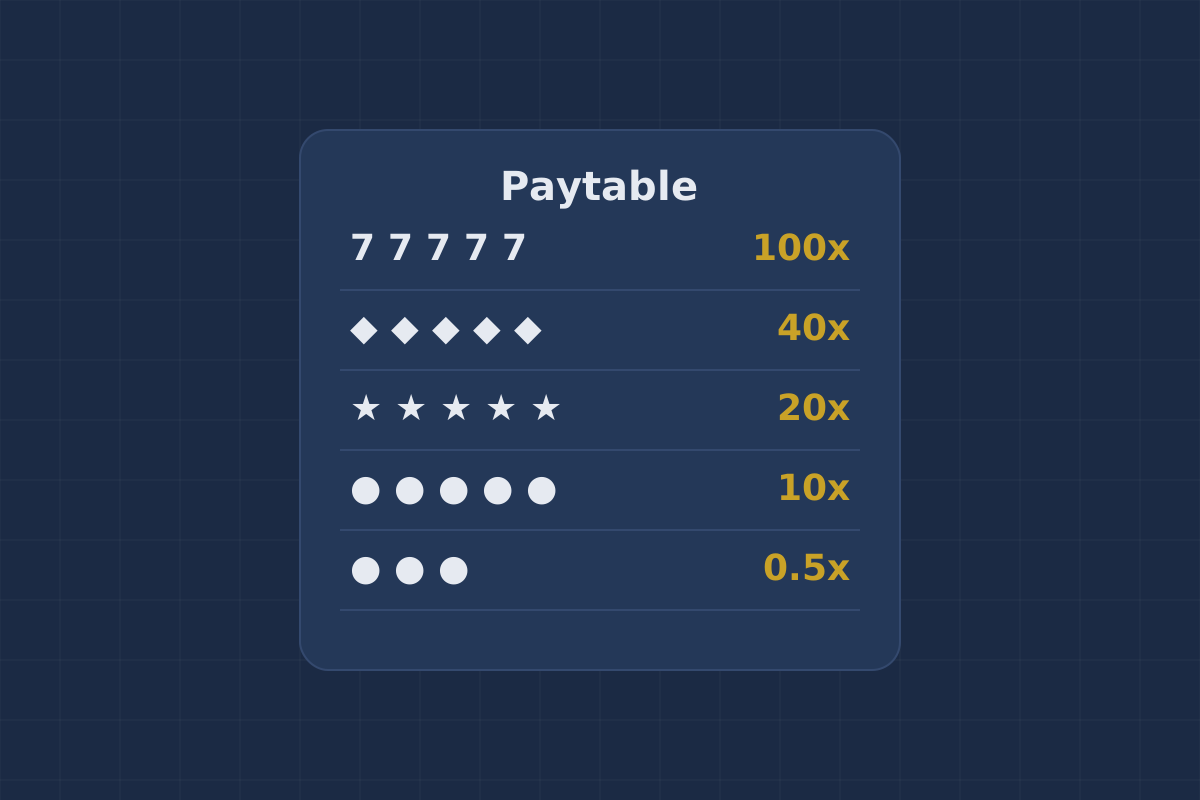
The paytable is the most useful screen in any slot and the one most often skipped. It tells you exactly what each combination awards, which symbols do special jobs and how features are triggered. UK technical standards require licensed games to make this information easy to find, describing pay-tables as one acceptable way to show potential prizes. What the standards cannot do is make every paytable use the same units. Some list values against the line bet, some against the total bet, and some mix both on one screen. This guide sets out a method you can apply to any game, then works through real examples from the SlotsRanker catalogue.
Step one: find the unit before reading any number
Every figure in a paytable is a multiple of something. The first job is to find out what.
- Total bet. Most modern games relate wins to the whole stake, either as multipliers or as coin values that update with it. A value of 10x means ten times what the spin cost.
- Line bet. Older line games often show values per line. The total stake is the line bet multiplied by the number of active lines, so a line value must be divided by that number to compare it with the spin cost.
- Coins or credits. Some tables show values for a specific stake level and update when the stake changes. In that case, divide the value shown by the current stake.
The help screen or the small print under the table usually says which unit applies. If it does not, change the stake and see whether the numbers move. Values that change with the stake are in coins; values that stay fixed are multipliers.
Step two: convert line values into total-stake terms
Cleopatra is the clearest example in our catalogue of why step one matters. Its published paytable, as reported in our review, lists values against the line bet on a 20-line game. The top line award is 10,000 for five Cleopatra wilds.
With 20 active lines, one total stake equals 20 line bets. So:
| Combination | Paytable value (line bets) | Divide by 20 | Total-stake equivalent |
|---|---|---|---|
| Five Cleopatra wilds | 10,000 | 10,000 / 20 | 500x |
| Five Scarabs | 750 | 750 / 20 | 37.5x |
| Three Scarabs | 25 | 25 / 20 | 1.25x |
| Three low card symbols | 5 | 5 / 20 | 0.25x |
The headline 10,000 is real, but on the scale most modern games use it becomes 500x the stake for that line. That is why our catalogue does not list 10,000x as Cleopatra's maximum win against the total stake.
Fishin Frenzy makes the same point with a smaller divisor. On its 10-line setting, the pelican's 2,000 line bets equal 200x the total stake. The Merkur build can also be played on 5 lines, which changes the divisor to 5 and the conversion with it.
Step three: check which symbols play by different rules
After the ordinary symbols, look for anything marked as wild, scatter or bonus. These often use their own scale.
In Cleopatra, the Sphinx scatter pays anywhere on the reels and is valued against the total bet rather than the line bet. Two Sphinx symbols pay 2x the total stake, three pay 5x, four pay 20x and five pay 100x, and three or more also start 15 free spins. Put on the line scale, five Sphinx symbols (100x the total) equal 2,000 line bets, the same as four Cleopatra wilds.
Cleopatra's wild adds a third rule: it doubles line wins it helps complete, except on lines made only of Cleopatra symbols, which are paid from the wild's own row. So two Scarabs plus one wild pay 50 line bets, or 2.5x the total stake, rather than 25. One screen, three scales. Reading each separately is the only way to know what a spin actually awarded.
Step four: read ways and pay-anywhere tables correctly
In a ways or pay-anywhere game, a paytable row describes one winning way or one qualifying group, not the whole spin.
Ways games. The Dog House Megaways 1000 pays per way. According to our review, six of the top premium symbol pay 7.5x the bet on a single way. If that symbol appears twice on each of two reels and once on the other four, it wins on 2 x 2 = 4 ways, so the base award is 4 x 7.5x = 30x before any wild multipliers. Pragmatic Play's page adds the multiplier rule: when more than one wild multiplier lands on the same spin, their values are multiplied together before being applied.
Pay-anywhere games. In Sweet Bonanza 2500 and Gates of Olympus 2500, rows are usually grouped by count bands, such as 8 to 9, 10 to 11 and 12 or more matching symbols. Position does not matter. In a tumbling game, each tumble is paid on its own, and the total for the spin is the sum.
Cluster games. Sugar Rush 1000 needs groups of five or more touching symbols, and its table scales with cluster size. Large clusters on a 7x7 grid are rare, so the upper rows describe uncommon outcomes.
Collector games. Pirots 5 does not use a symbol-combination table at all for its gems. Each gem colour has a value ladder that rises with its level, from 0.05x for the lowest blue gem up to 25x for the highest red one, according to our review.
Step five: find the rows that pay less than the stake
Once values are in total-stake terms, look for any below 1x. These are wins that return less than the spin cost. In Cleopatra, three low card symbols return a quarter of the stake. In a ways game, a single low-symbol way often returns a fraction of the stake too.
This matters because games used to celebrate these results as if they were wins. Research by Dixon and colleagues, published in the journal Addiction in 2010, found that players reacted physiologically to these "losses disguised as wins" in much the same way as to genuine wins. UK-licensed online slots are no longer allowed to celebrate returns equal to or below the stake. Reading the table yourself is still the most reliable way to know whether a spin was a gain or a smaller loss.
A simple habit helps: after a win, compare the amount shown with the spin cost. If the win is smaller, your balance went down, even if a number flashed on screen.
What a paytable leaves out
A paytable tells you what each outcome awards. It does not tell you how often each outcome happens. Reel strips are weighted, and that weighting is not published. Two symbols with neighbouring values can have very different frequencies.
To judge frequency, you need the other figures in the information screen: the RTP, hit frequency where published and the max win. The Gambling Commission's guidance reminds players that RTP is an average over a significant number of plays, not each session. Our guide to RTP and volatility explains how those numbers fit together.
A paytable also changes with the version. Cleopatra's review notes that some symbol sets and lower values vary between builds, so the in-game table is always the final word over any printed list, including ours.
A checklist to use on any new game
- Identify the unit: total bet, line bet or coins.
- Count the active lines if values are per line, and divide.
- Note every symbol with a special rule and its own scale.
- For ways, clusters or pay-anywhere games, remember each row is one way or one group.
- Mark every value under 1x total stake.
- Read the feature rules for multipliers and whether they add or multiply.
- Check the RTP and version in the same information screen.
Frequently asked questions
Why does Cleopatra show 10,000 when its maximum is not 10,000x the stake?
Because the 10,000 is a multiple of the line bet. On 20 lines it equals 500x the total stake for that line.
How do I know whether a paytable uses line bet or total bet?
Check the help text, or change the stake. Coin values that change with the stake need dividing; fixed multipliers do not.
Do scatter wins use the same scale as line wins?
Not always. Cleopatra's Sphinx scatter pays against the total bet, while its line wins use the line bet.
What does a pay-anywhere paytable row mean?
It gives the value for a band of matching symbols anywhere on the grid, such as 8 to 9 symbols, regardless of position.
Can a win be smaller than my stake?
Yes. Many low-value combinations return less than the spin cost, which means the balance falls even though a win is shown.
Does the paytable show how likely each win is?
No. It lists awards only. Frequencies depend on unpublished reel weighting, summarised by the RTP and hit frequency.
Sources
- gamblingcommission.gov.uk/standards/remote-gambling-and-software-technical-standards/rts-3-r…
- gamblingcommission.gov.uk/public-and-players/guide/return-to-player-how-much-gaming-machines…
- pragmaticplay.com/en/games/the-dog-house-megaways-1000
- onlinelibrary.wiley.com/doi/10.1111/j.1360-0443.2010.03050.x