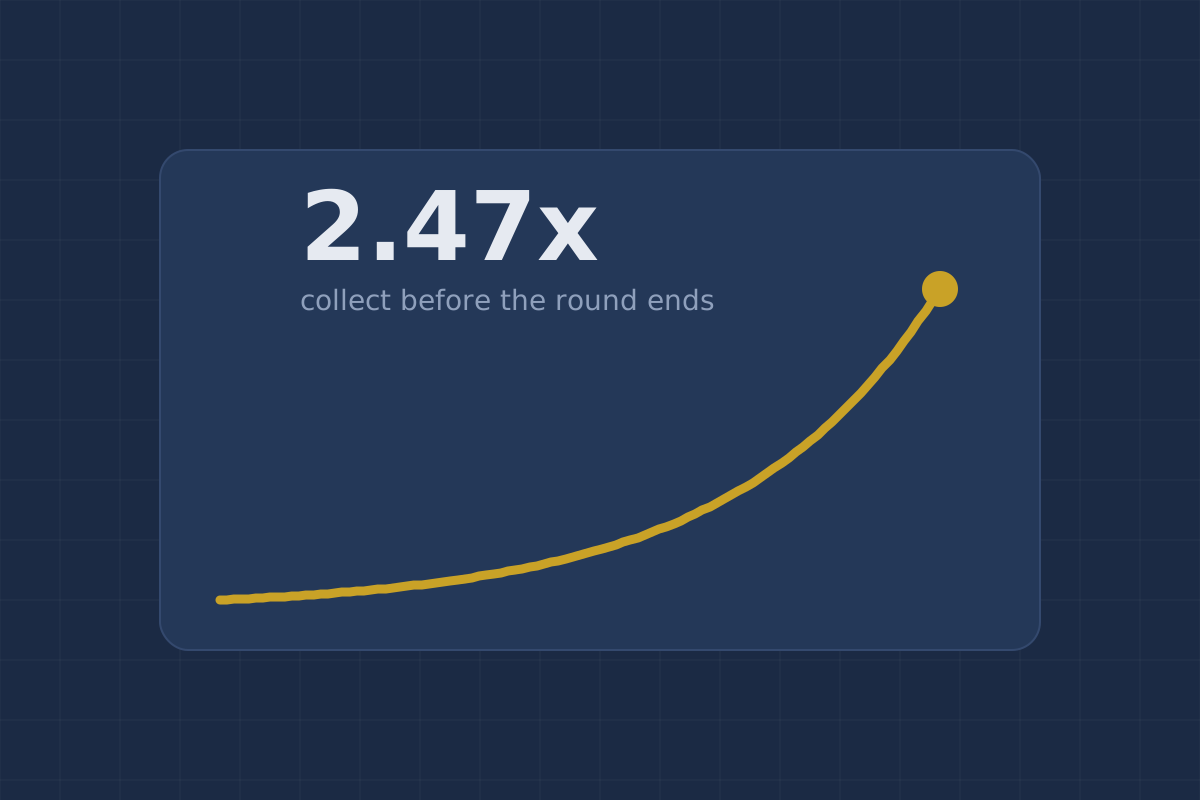
Crash games strip gambling-style play down to one visible number and one button. A multiplier starts at 1x and rises, and at a moment you cannot see coming, the round ends. Collect before that moment and the stake is multiplied by whatever the counter shows. Wait too long and the stake is gone. There are no reels, paylines or symbol tables to learn. What is worth learning is where the result actually comes from, because the tension on screen suggests a race against the game that does not really exist. This guide uses the crash and instant titles in our catalogue, all played with virtual coins.
The one-button round, step by step
Aviator, released by Spribe in February 2019, is the format most people picture. A round runs like this:
- Stake before take-off. Between rounds, you set a stake and confirm it. Nothing can be added once the plane is airborne.
- The climb. The multiplier starts at 1x and rises as the plane flies.
- Collect. At any point in flight you can collect. The result is the stake multiplied by the figure on screen at that moment.
- Fly-away. The plane leaves at a multiplier that was fixed before the round began. Any stake still running is lost.
- History. The result joins the round history, and the next betting window opens.
Aviator's rules add two practical details covered in its review. You can run two stakes in the same round using two separate panels. Each panel also has an automatic collect setting, which settles the stake the instant the flight reaches a target you enter.
The crash point is chosen before the round starts
The most important sentence in any crash game's rules is the one saying when the result is generated. For Aviator, the fly-away multiplier is produced by the provably fair system before take-off. Nothing you do during the flight moves it.
That changes how the game should be read. Watching the plane climb is not a contest of nerve against a live system. The flight is a reveal of a number that already exists. Collecting early or late only decides which part of that pre-set flight your stake takes part in.
It also rules out the most common crash-game belief: that a streak of low results means a high one is coming. Each round's result is generated independently. The UK remote technical standards require game outcomes to be unpredictable, and the round history panel is a record of the past, not a signal about the future.
How the rising number is priced
Spribe publishes a 97% RTP for Aviator. Analysts who have worked through the published fairness data describe the result formula in a simple way: the chance of the plane reaching a multiplier m is roughly 0.97 divided by m. These figures are an independent reconstruction, not a table issued by Spribe, and they include rounding, but they show the principle clearly.
| Collect target | Approximate chance of reaching it | Long-run return per 100 coins |
|---|---|---|
| 1.5x | about 64.70% | about 97 |
| 2x | about 48.50% | about 97 |
| 10x | about 9.7% | about 97 |
| 100x | about 0.97% | about 97 |
Take the 2x row as a worked example. If 1,000 rounds are each played with a 1-coin stake and a 2x target, about 485 would succeed on average, returning 970 coins in total from 1,000 staked. With a 10x target, about 97 rounds would succeed, and those 97 would also return 970 coins. The long-run figure is the same; the path is completely different. The low target gives many small results and frequent losses of single stakes. The high target gives long runs of losses broken by rare large results.
That is why a crash game has no fixed volatility. You set it with your target. No target or pattern of targets changes the 97%.
What "provably fair" means in practice
Many crash and instant games advertise provably fair rounds. Spribe's own explanation describes the method in four parts:
- The operator generates a server seed, and a hashed version of it is shown publicly before the round starts.
- Client seeds are generated on the players' side.
- When the round starts, the server seed and client seeds are combined and hashed with SHA-512.
- The round result is derived from that hash, using maths that differs slightly from game to game.
Spribe says the next round's server seed hash can be viewed in the Provably Fair settings, and that any finished round can be checked from the game history by opening the fairness icon, which shows the server seed, player seeds, combined hash and result.
The value of this is specific. Because the hash is shown before the round, the result cannot be changed after stakes are placed without the check failing. What provably fair does not do is remove the house edge. A round can be perfectly verifiable and still belong to a design that keeps about 3% of stakes over the long run. It also cannot help predict anything: you verify a round after it ends, you do not forecast the next one.
Four other instant formats in the catalogue
The same collect-or-continue idea turns up in several shapes.
Chicken Road (InOut, 98% RTP). Instead of a climbing line, you move a chicken across the road one lane at a time. Each safe step raises the multiplier, and you can collect at any step. Four difficulty settings change the number of lanes and the risk per step: Easy has 24 steps, Medium 22, Hard 20 and Hardcore 15. Its review shows how the published multipliers match a fixed return at every stopping point, the same principle as Aviator's table.
Ice Fish (InOut, 95.5% RTP, 5,000x max). This is closer to a wheel than a crash game. A 45-sector wheel mixes two large anchor bets with seven fish bonus sectors, and pre-spin multipliers can boost results. There is no collect decision during the spin; the choice is where the chips go.
Plinko+ (Pragmatic Play, 97.5% RTP, 1,000x max). A ball drops through a pyramid of pins into buckets. You choose a board of 8 to 16 lines and a low, medium or high risk setting. The smallest multipliers sit in the middle and the largest at the edges, and the top bucket appears only on the tallest, highest-risk board.
Winter Fishing Club (BGaming, 97.16% RTP, 3,000x max). One cast per round, with three hookbaits that change the risk. BGaming labels it Medium-low volatility, and its published hit rate shows that most casts return nothing.
Power Keno (IGT, 94.97% RTP) sits in the same section of the site. It is a number draw rather than a crash game: 20 balls from 80, with a 4x multiplier if the final ball is one of your numbers.
Where crash games differ from slots
- The decision is yours, the result is not. A slot has no choice once the button is pressed. A crash game lets you choose a collect point, which shapes how results are spread but not the long-run return.
- Rounds can be shared. Aviator runs the same flight for everyone playing at that moment, with live stake lists and chat. Chicken Road and Plinko+ are single-player.
- Maximum results are often unsettled. Slots publish a cap. For Aviator, sources quote very different maximums and Spribe's rules summary gives none, so SlotsRanker lists it as not verified. Chicken Road's catalogue entry is marked the same way.
- No slot-only features. Crash games have no Megaways, wilds or feature purchases, and our catalogue does not tag them with those labels.
Keeping the pace in check
Crash rounds are short. Spribe's platform partner GR8 Tech describes rounds across its titles as lasting under 30 seconds, and automatic stake and collect settings can keep rounds running without any input. That speed is worth noticing even with virtual coins. Setting a round limit before you start is simpler than deciding to stop mid-streak, and our guide to playing responsibly covers practical ways to do that.
Frequently asked questions
Is the crash point decided during the round?
No. In Aviator the multiplier is generated before take-off by the provably fair system, and nothing during the flight changes it.
Does collecting early improve the long-run return?
No. Based on analysis of Aviator's published algorithm, every collect target carries the same long-run return of about 97%. Early targets just succeed more often and pay less.
What does provably fair actually prove?
That the round result was fixed before stakes were placed and was not altered afterwards. It does not remove the house edge.
How do I check an Aviator round?
Spribe says to open the game history and select the provably fair icon for that round, which shows the seeds, combined hash and result.
Are Plinko and Chicken Road crash games?
They belong to the same instant-game family. Chicken Road uses a step-by-step collect decision; Plinko+ settles each ball with no decision after the drop.
Why is there no maximum win listed for Aviator?
Sources disagree and Spribe's rules summary does not give a figure, so we list it as not verified.