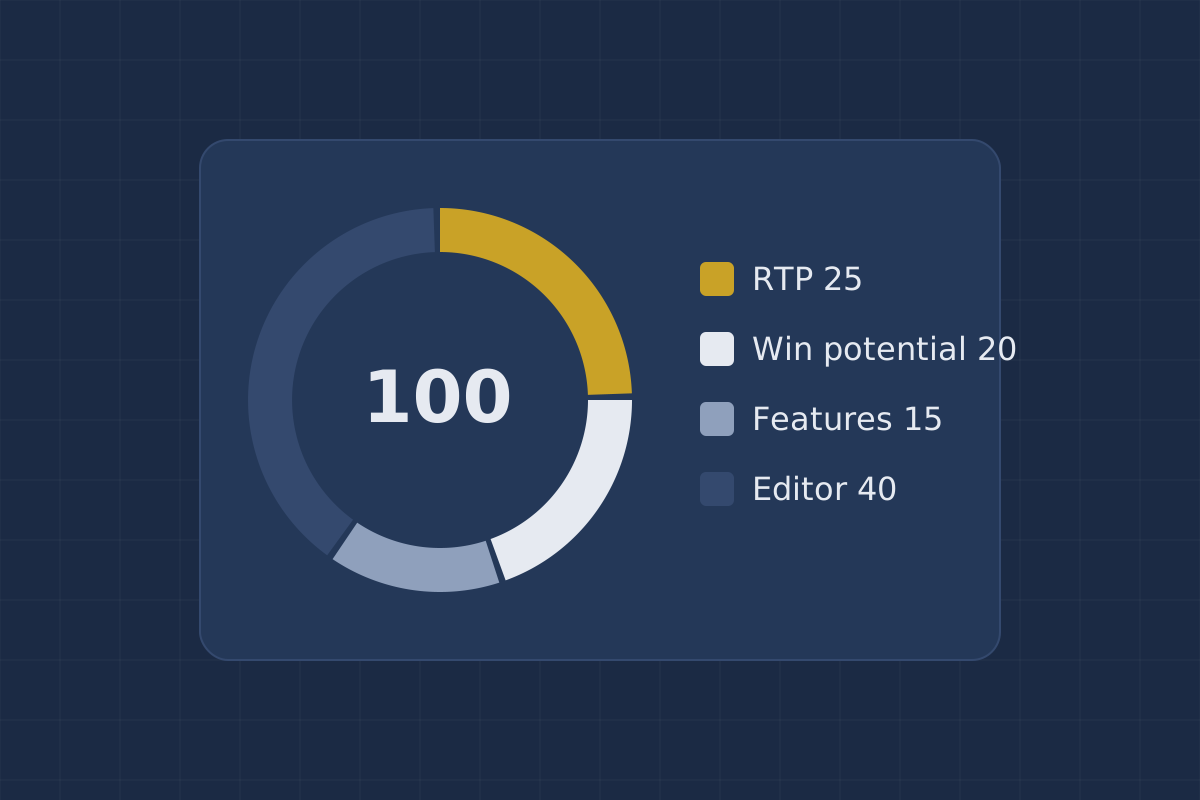
Every scored game on SlotsRanker will carry a number from 0 to 100 called the SR Score. A score is only useful if readers can check it, so this guide sets out exactly how each part is calculated, using the same formulas the site applies, and works them through for real games in the catalogue. It also explains what you will actually see on game pages today: a breakdown of the published-data components under the heading "SR Score components", without an overall total, because the editor testing that completes a score is still under way. Our How we rank page gives the short version; this is the long one.
The 100 points and where they come from
The SR Score has four components with fixed maximums:
| Component | Maximum points | Source |
|---|---|---|
| RTP | 25 | The published return to player |
| Win potential | 20 | The published maximum win |
| Features | 15 | Mechanics listed in the game record |
| Editor testing | 40 | A structured editorial assessment |
The four maximums add up to 100, and no component can exceed its own maximum. Three components are calculated directly from published data. The fourth, the largest, comes from an editor.
Once a game has a full score, it is placed in a tier:
| Score | Tier |
|---|---|
| 90 and above | Top tier |
| 80 to 89 | High tier |
| 70 to 79 | Rated |
| Below 70 | Ranked |
The tier changes the badge colour only. It never changes the number.
The RTP component: 5 points for every percentage point above 92%
The formula is:
RTP points = (published RTP − 92) × 5, rounded to the nearest whole number, then held between 0 and 25.
In plain terms, a game at 92% or below earns nothing from this component, each 0.2 percentage points above 92% adds one point, and any game at 97% or above receives the full 25. The scale is deliberately narrow because most slot RTPs sit between the low 90s and the high 90s, and a wider scale would flatten the differences that matter.
Worked examples from the catalogue:
- Big Bass Splash, 96.71%: (96.71 − 92) × 5 = 23.55, rounded to 24.
- Gates of Olympus 2500, 96.52%: 22.6, rounded to 23.
- Cleopatra, 95.02%: 15.1, rounded to 15.
- Plinko+, 97.5%: 27.5, held at the cap of 25.
The component uses the default published figure in the game record. Where a studio lists several versions, we do not silently pick the highest. If the applicable figure cannot be established, the game stays unscored. The Gambling Commission's guidance is a useful reminder of why this component is capped at a quarter of the score: RTP is an average over a very large number of plays, not a description of any one session.
The win potential component: a logarithmic scale for maximum wins
Maximum wins in the catalogue range from 88x to 30,000x, so a straight-line scale would not work. The site uses a base-10 logarithm:
Win potential points = log10(maximum win) × 5, rounded, then held between 1 and 20. A game with no published maximum receives 0.
Each tenfold increase in the maximum adds five points:
| Published max win | Calculation | Points |
|---|---|---|
| 10x | 1 × 5 | 5 |
| 100x | 2 × 5 | 10 |
| 1,000x | 3 × 5 | 15 |
| 5,000x | 3.699 × 5 = 18.49 | 18 |
| 10,000x | 4 × 5 | 20 |
| 25,000x | 4.398 × 5 = 21.99 | 20 (capped) |
So Big Bass Splash at 5,000x receives 18, Plinko+ at 1,000x receives 15, and Gates of Olympus 2500 and Duck Hunters both hit the cap of 20 despite their different ceilings of 25,000x and 30,000x. Games whose maximum is not verified, such as Cleopatra and Fishin Frenzy, receive 0 rather than an estimate.
The logarithm is a deliberate choice. It recognises that a 10,000x ceiling represents a different design from a 100x one, while preventing very large caps from dominating the score. A maximum win is a design ceiling expressed as a multiplier, not an expected result.
The features component: 3 points per documented mechanic
Feature points = number of feature entries in the game record × 3, capped at 15.
A feature entry is a distinct mechanic listed in the published game record, such as a tumble system, a free spins round or a multiplier wild. Five documented features reach the cap.
At the time of writing:
- Big Bass Splash lists four entries (free spins with the fisherman collect, the retrigger multipliers, pre-bonus modifiers and a bonus buy), giving 12.
- Gates of Olympus 2500 also lists four, giving 12.
- Cleopatra lists three, giving 9.
- Fishin Frenzy and Plinko+ each list two, giving 6.
Only mechanics genuinely present in the game family count. Crash, table and card games are never tagged with slot-only labels such as Megaways or bonus buy. A simple game can still rank well on its other components, but this part stays appropriately lower.
The editor component: 40 points, and why it is still pending
Editorial assessment is the largest component because published specifications cannot describe everything that matters. The site's methodology lists what editors evaluate: rule clarity, interface readability, thematic coherence, pacing, how accessible the controls are, the quality of feedback and whether the bonus follows logically from the base game. Editors also record specific strengths and limitations, and generic praise does not justify a high score. Commercial relationships and advertising placements cannot buy points.
This component is currently set to zero for every game because editor testing has not been completed. Game pages show the published-data bars with their values out of 25, 20 and 15, and the editor bar is labelled "Editor testing pending". The overall badge does not appear. The site does not publish a partial score, because a number out of 100 with 40 points missing would look like a poor rating rather than an unfinished one.
Putting it together: two worked breakdowns
Big Bass Splash today: RTP 24/25, win potential 18/20, features 12/15, editor pending. The data components total 54 of their 60 available points. The eventual score will be 54 plus the editor's assessment out of 40.
Cleopatra today: RTP 15/25, win potential 0/20 (maximum not verified against the total stake), features 9/15, editor pending. The data components total 24 of 60.
The gap between them is mostly win potential and RTP, and it shows how a classic line game with an unverified ceiling sits lower on the data side. The editor component, worth 40, can narrow or widen that gap.
The unscored rule
A game with no published RTP receives no breakdown at all. Sugar Rush 1000 is an example: the studio figure varies by version, so the catalogue does not record one, and its page says it is not scored yet because the published data is incomplete. The site does not substitute an industry average, infer a value from play or treat missing data as zero. The game stays in the catalogue so its mechanics can still be read.
How rankings are ordered in the meantime
Because no game yet has a complete score, ranking pages do not sort by SR Score. Until testing is complete, order and movement come from monthly play counts across the sites that share our demo game catalogue. The main rankings are recalculated monthly and the Trending list weekly. Movement arrows compare a game's new position with its previous valid position, and "New" means only that no earlier position exists.
Player ratings are shown separately and are not part of the SR Score. Community preference and editorial assessment answer different questions.
What the score will never measure
The SR Score does not measure luck, predict a session or say how many virtual coins anyone will finish with. It does not reward popularity, branding or advertising. If a game's published data changes, or a review finds an error, the affected components are recalculated. See RTP and volatility explained for why the underlying figures describe design rather than outcomes.
Frequently asked questions
Why do game pages not show an overall score yet?
The editor component, worth 40 points, is still pending for every game. The site does not show an incomplete total.
How is the RTP component calculated?
Take the published RTP, subtract 92, multiply by 5 and round. The result is held between 0 and 25.
Why do 25,000x and 30,000x games get the same win potential points?
The logarithmic scale reaches its 20-point cap at 10,000x, so any higher maximum also receives 20.
What happens if a game has no published maximum win?
It receives 0 for win potential rather than an estimated value.
Can a studio or advertiser pay for a higher score?
No. Commercial relationships and ad placements cannot add points.
How are rankings ordered before scores are complete?
By monthly demo play counts across the shared catalogue, recalculated monthly for the main lists and weekly for Trending.
Sources
- gamblingcommission.gov.uk/standards/remote-gambling-and-software-technical-standards/rts-3-r…
- gamblingcommission.gov.uk/public-and-players/guide/return-to-player-how-much-gaming-machines…
- gamblingcommission.gov.uk/about-us/freedomofinformation/consumer-misunderstanding-of-return-…
- pragmaticplay.com/en/games/big-bass-splash
- pragmaticplay.com/en/games/gates-of-olympus-2500