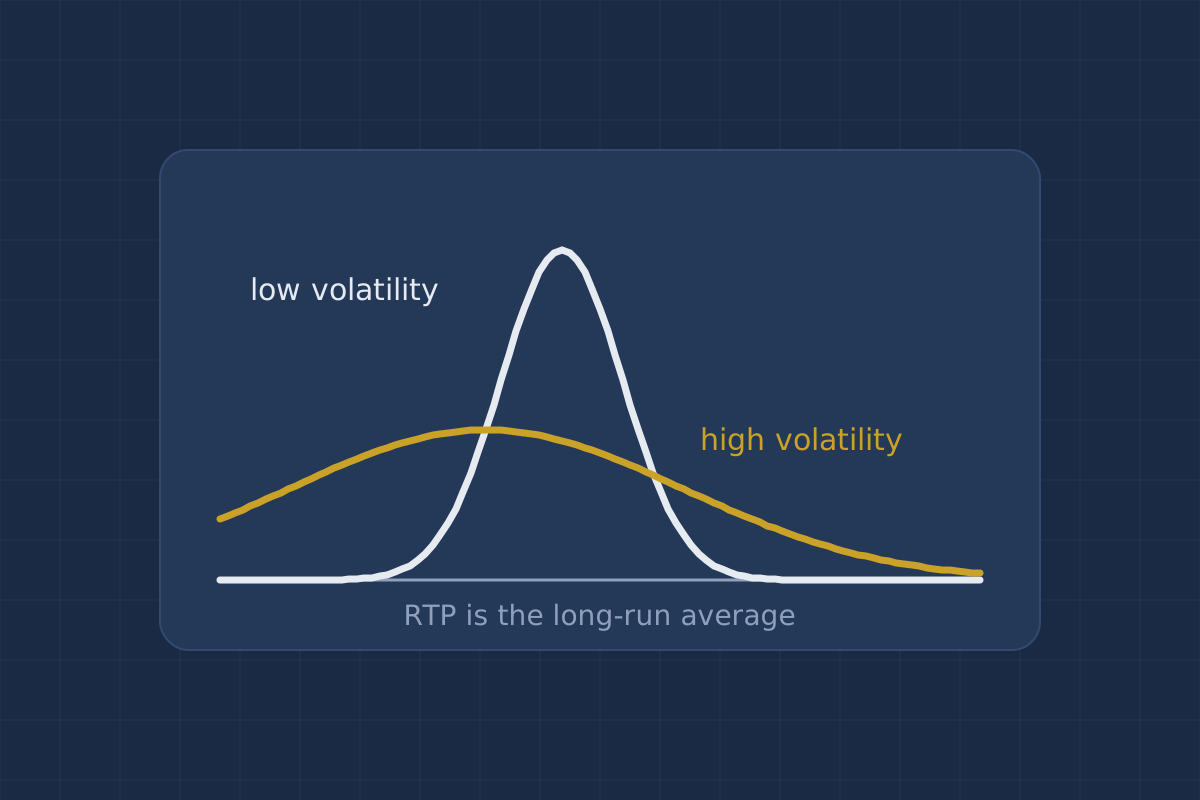
Almost every game page on SlotsRanker shows two headline figures: RTP and volatility. They are the most quoted numbers in slot design and the most misread. RTP is often treated as a promise about a session, and volatility is often treated as a mood. Neither reading holds up. This guide takes both figures apart with arithmetic, using real specs from our catalogue, so you can see what each number measures and where its usefulness stops.
RTP in one sentence, and the part people skip
Return to player is the share of everything staked that a game is designed to hand back over a very large number of rounds. The Gambling Commission's consumer guidance puts the important qualifier plainly: RTP is an average achieved over a significant number of plays, not each time the game is played. Its own example is a machine showing 85% RTP, where a player should not expect to get back that proportion of each stake during a single session.
The skipped part is "very large". RTP is a property of the maths model, calculated across every possible outcome and its probability. A session of a few hundred spins samples only a tiny slice of that model, and the slice can look nothing like the whole.
UK standards require that information about the likelihood of winning, such as the RTP or the probability of winning events, is easily available before play. RTS 3C lists the average theoretical RTP as one acceptable way to meet that requirement. That is why the figure usually sits in a game's information screen.
A worked example: 96.5% over 1,000 spins of 1 coin
The Dog House Megaways 1000 lists a default RTP of 96.5%. Suppose you imagine 1,000 spins at 1 virtual coin each.
- Total staked: 1,000 coins.
- Long-run average return at 96.5%: 965 coins.
- Long-run average retained by the game: 35 coins, which is the 3.5% house edge.
That 965 is an average across an enormous number of imagined 1,000-spin sessions, not a forecast for one. Many of those sessions would end well below 965 and some would end far above it, because a large part of this game's return is concentrated in rare wild combinations and bonus rounds. Its review notes a published free spins frequency of roughly 1 in 388 spins, so a 1,000-spin sample could contain two or three bonus rounds, or none. Those rounds alone can swing the result by hundreds of coins either way.
The honest reading of 96.5% is therefore: "across all possible play, this design returns 96.5% of stakes". It is not "I will get 965 coins back".
Why the same game can have several RTP figures
Studios often build one game in several RTP configurations and let the distributor choose. The catalogue records several examples:
| Game | Default RTP | Other published versions |
|---|---|---|
| Pirots 5 | 96% | 94%, 92%, 90%, 87% |
| Eye of Horus | 96.31% | 94.83%, 92.44%, 90.25%, 88.26% |
| Big Bass Splash | 96.71% | 95.67%, 94.60% |
| Gates of Olympus 2500 | 96.52% | 95.50%, 94.50% |
The artwork, rules and features are the same in each version. What changes is the underlying weighting. Using the Eye of Horus range and 10,000 coins staked over the long run:
- At 96.31%, the average return is 9,631 coins.
- At 88.26%, the average return is 8,826 coins.
That is a gap of 805 coins per 10,000 staked, on a game that looks identical. The version in front of you is normally stated in the game's help or information screen, which is the figure to trust over any list. SlotsRanker shows the default published figure, and where the applicable figure is not clear we say so rather than picking the highest one.
Base-game RTP, feature RTP and the Lucky Pharoah case
An RTP figure usually covers the whole game, base spins and bonus rounds together. A few games publish separate figures for different modes. Lucky Pharoah lists 94% for the base game and 96.25% while Power Spins are being played. That is not two versions of the game; it is one game where the optional mode is built to return more of each stake. The catalogue shows 94%, the base-game figure.
Special stake modes work in a similar way. Ante bets and feature purchases in games such as Sweet Bonanza 2500 change what each spin costs and how often the bonus appears. Studios do not always publish a separate RTP for each option, and our bonus buy guide explains why it is unsafe to assume every mode returns the headline figure.
Volatility: the shape of the results, not the size of the return
Volatility (sometimes called variance) describes how unevenly a game distributes its RTP. Two games can both return 96% over the long run while behaving in completely different ways along the way.
- A low volatility game returns its share through frequent, modest wins. Results cluster near the average, and long empty runs are less common.
- A high or extreme volatility game holds back much of its return for rare, large outcomes. Most spins return little or nothing, and the average is pulled up by results that many sessions never see.
There is no single industry formula for the label. Studios choose their own scales, and databases sometimes disagree with the studio. For The Dog House Megaways 1000, Pragmatic Play publishes no volatility rating at all, so our catalogue leaves it blank rather than borrowing one.
Comparing four volatility labels from the catalogue
| Game | RTP | Volatility | Max win |
|---|---|---|---|
| Plinko+ | 97.50% | Low | 1,000x |
| Fishin Frenzy | 96.12% | Low-Med | — |
| Pirots 5 | 96% | Medium-High | 10,000x |
| Duck Hunters | 96.05% | Extreme | 30,000x |
Pirots 5 and Duck Hunters are separated by only 0.05 percentage points of RTP, yet one is labelled Medium-High and the other Extreme. The maximum win gives a hint about why: a game that can award 30,000x the bet has to fund that possibility from somewhere, and it does so by making many ordinary spins leaner. Duck Hunters' reported hit frequency of 17.07% means fewer than one spin in five returns anything at all.
Plinko+ is a useful contrast. Pragmatic Play labels it Low, but its top 1,000x bucket only exists on the 16-line high-risk setting, according to its review. The player's own settings change how uneven the results are, which is common in instant games and covered in our crash games guide.
Hit frequency: the third number worth reading
Where a studio publishes it, hit frequency tells you how often a spin returns something. Sweet Bonanza 2500 lists about 1 in 2.33 spins (42.9%). Gates of Olympus 2500 lists about 1 in 3.58 spins (27.93%).
A hit is not the same as a profit. Many hits return less than the stake, which is why a high hit rate can sit alongside high volatility. Researchers have described returns smaller than the stake as "losses disguised as wins" when a game celebrates them, and the UK regulator has banned that kind of celebration in licensed slots.
What RTP means for table games and skill decisions
Table games in the catalogue often show higher figures: Premium Blackjack lists 99.58% and Baccarat 98.94%. In blackjack the figure depends on decisions. UK guidance says that where a game involves skill, the RTP should be calculated using the automatic strategy or a standard published strategy. A player who departs from that strategy is not playing the game the figure describes, so the listed RTP is a ceiling for good decisions, not a guarantee.
Common misreadings to avoid
- "A 97% game is safer than a 94% game." Over the long run it keeps less of each stake, but over a short session volatility can easily outweigh a three-point gap.
- "The game is below its RTP, so it must catch up." For a random game, past rounds do not affect future ones. The Gambling Commission contrasts random machines with compensated ones for exactly this reason.
- "Low volatility means low risk." It means steadier results. The house edge is still there, taken in smaller, more frequent pieces.
- "Volatility labels are standard." They are not. Compare labels within one studio's range, and treat third-party labels with care.
Frequently asked questions
Does 96% RTP mean I get 96 coins back for every 100 I stake?
Only as a long-run average across a vast number of rounds. A single session can end far above or below that figure.
Can the same game really have different RTPs?
Yes. Studios such as ELK Studios and Pragmatic Play publish several configurations of one title. The rules look the same, but the long-run return differs.
Where do I find the RTP for the version I am playing?
In the game's information or help screen. That figure applies to the build in front of you.
Is high volatility better or worse than low volatility?
Neither. It is a description of how results are spread. Pick the pattern you find more comfortable, bearing in mind that both carry a house edge.
Why does SlotsRanker show "not published" for some volatility figures?
Because the studio has not published one, and we do not substitute a third-party label as fact.
Does a higher hit frequency mean I will finish ahead?
No. Many hits return less than the stake, and the RTP still describes the long-run return.
Sources
- gamblingcommission.gov.uk/public-and-players/guide/return-to-player-how-much-gaming-machines…
- gamblingcommission.gov.uk/authorities/guide/page/la-bulletin-august-2020-feature-article
- gamblingcommission.gov.uk/standards/remote-gambling-and-software-technical-standards/rts-3-r…
- gamblingcommission.gov.uk/about-us/freedomofinformation/consumer-misunderstanding-of-return-…
- pragmaticplay.com/en/games/sweet-bonanza-2500