An online slot looks like a machine with spinning drums, but nothing on screen is spinning in any mechanical sense. The result of each round is settled by software the moment you press the button, and the animation that follows is a presentation of a decision already made. Once that idea is clear, the rest of slot design becomes much easier to follow: paylines, ways, tumbles and bonus rounds are all different ways of reading one random result. This guide walks through that process in order, using games from the SlotsRanker catalogue as examples. Everything here is played with virtual coins, and nothing in it predicts how any session will go.
What happens between pressing spin and the reels stopping
A modern slot has three layers. The first is a random number generator, usually shortened to RNG, which produces a constant stream of numbers with no usable pattern. The second is the game logic, which takes the numbers it needs and maps them onto positions on each reel. The third is the display, which animates the reels and lands them on the positions the logic has already chosen.
In the UK, the Gambling Commission's remote technical standards set out what that first layer must do for licensed games. RTS 7 requires the output of the RNG and the game outcomes to be unpredictable, and it requires any scaling applied to the numbers to keep those qualities. In plain terms, turning a very large random number into "reel 3, position 41" must not introduce a bias that the maths model does not already account for.
The sound of reels slowing and the pause before the last one lands belong to the third layer. None of it changes what the first two layers decided.
Reel strips, symbol weighting and why a reel is not a dice
Each reel in a slot is defined by a reel strip: a list of symbols in a fixed order. A strip might be 30 symbols long or several hundred. When the logic picks a stop position, the visible window shows that position and its neighbours.
This is where slots differ from a dice. On a fair six-sided dice, each face appears once, so each has the same chance. On a reel strip, a designer can place the low-paying card symbols many times and the top symbol only once or twice. Two symbols that look equally common on screen can have very different chances of landing. That weighting, spread across all reels, is how a studio shapes the game's return to player (RTP) and its volatility.
It also explains why watching cannot reveal the odds. The strips behind the 5x3 window of Cleopatra are not published. What studios do publish is the paytable and, usually, the RTP, which summarise the effect of that weighting. Our guide to reading a paytable covers the first; RTP and volatility explained covers the second.
Four ways a slot decides whether a spin pays
Once the reels have stopped, the game checks the window against its win rules. There are four common systems in our catalogue, and they produce quite different feels even when the RTP is similar.
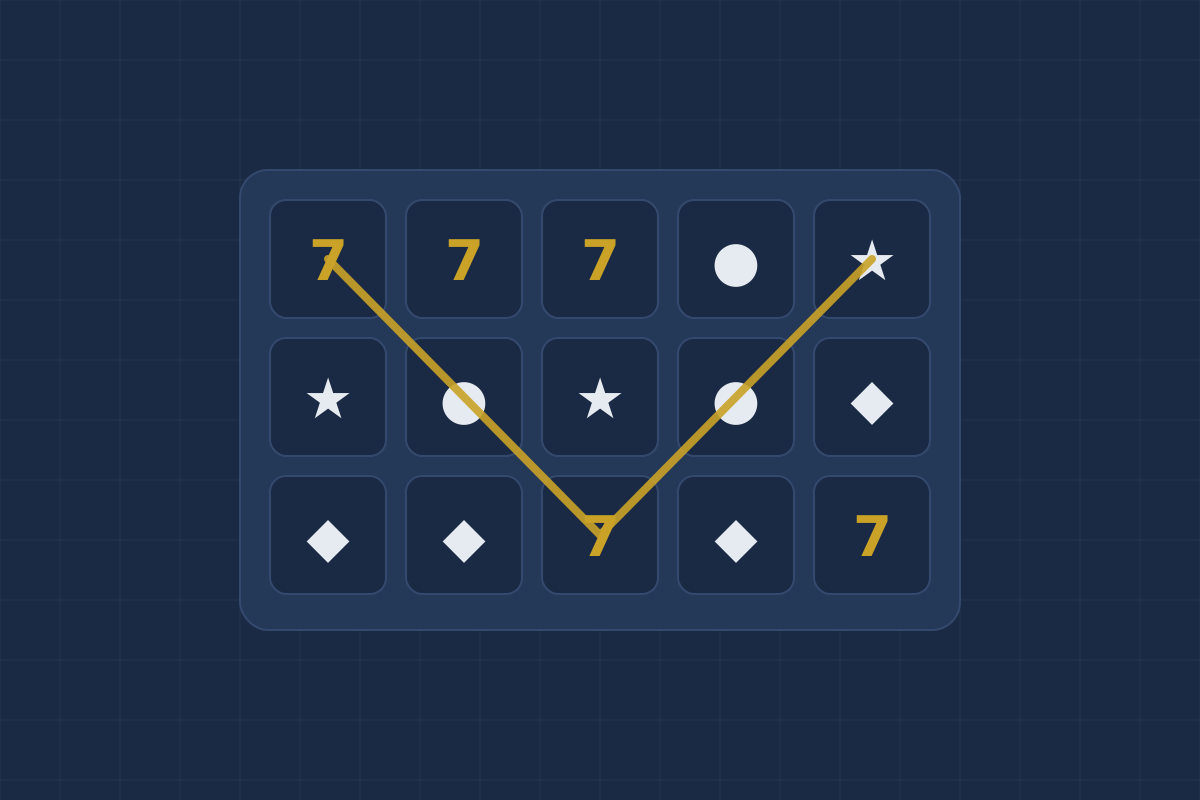
Fixed paylines. A payline is a set path across the reels, usually starting on reel 1. Cleopatra uses 20 lines on a 5x3 grid, and Big Bass Splash uses 10 fixed lines. A win needs matching symbols from left to right along one of those paths. A symbol sitting one row off the line does not count.
Ways to win. Instead of fixed paths, a ways game pays for matching symbols on adjacent reels in any row. Huff N' Even More Puff Grand uses 243 ways on a 5x3 grid, which is simply 3 x 3 x 3 x 3 x 3. White Orchid is unusual because it offers both: 40 paylines, or 1,024 ways with its MultiWay Xtra option at a higher stake. Megaways games take the ways idea further by changing reel heights on every spin, which our Megaways guide explains in detail.
Pay anywhere. Some grids ignore position entirely. Sweet Bonanza 2500 and Gates of Olympus 2500 both use a 6x5 grid where eight or more matching symbols anywhere on screen form a win. Pragmatic Play's own page for Sweet Bonanza 2500 describes wins starting from eight matching symbols.
Clusters and collectors. Sugar Rush 1000 pays for groups of five or more matching symbols that touch horizontally or vertically on a 7x7 grid. Pirots 5 goes a step further with ELK Studios' CollectR system, where collector birds move across a 6x6 grid gathering matching gems.
Tumbles, collectors and the modern spin loop
Older slots settle everything in one step: reels stop, wins are paid, and the next spin starts. Many newer games add a loop inside the spin.
In a tumble (also called a cascade), winning symbols are removed after they are paid, the symbols above drop into the gaps, and new symbols fall in from the top. If the new arrangement forms another win, it pays and the process repeats. The spin only ends when a tumble produces nothing. Sweet Bonanza 2500, Gates of Olympus 2500 and Sugar Rush 1000 all work this way.
This matters for how you read a single spin. One press of the button can contain several separate evaluations, each drawing fresh symbols. The RNG is still behind every new symbol that drops in, and the RTP figure already includes all of those chained wins. A long chain is not a sign that the game has "warmed up"; it is one possible result of the same maths.
Where bonus rounds fit into the maths
Most video slots contain a second game, usually a set of free spins, triggered by scatter symbols. In Big Bass Splash, three, four or five scatters start 10, 15 or 20 free spins, and during that round a fisherman wild collects the values shown on fish symbols. In Eye of Horus, three or more scatters start 12 free games in which each Horus wild upgrades a picture symbol.
The important point is that the bonus round is part of the published RTP, not an extra on top. If a game returns 96.71% over the long run, as Big Bass Splash does in its default version, a large share of that figure may come from free spins that arrive only occasionally. The base game on its own returns less. That is the main reason two games with the same RTP can feel so different: one spreads its return evenly across ordinary spins, the other holds much of it back for rare rounds.
Some games have no free spins at all. Lucky Pharoah replaces them with a choice after any win of 4x the bet or more: collect it, or turn it into Power Spins on four reel sets. Fortune Garuda 500 puts its weight on a special multiplier reel beside a 3x3 grid. The slot features glossary lists these mechanics by name.
Why the last spin tells you nothing about the next
The Gambling Commission separates two kinds of gaming machine in its consumer guidance. A random machine relies purely on chance, and the odds of the current game are not affected by earlier wins or losses. A compensated machine varies its chances according to previous results. Online slots of the kind in our catalogue are described by their studios as random, and the RTS requirements above are written around unpredictable, independent outcomes.
For a random game, a run of empty spins does not make a bonus more likely, and a big result does not make the next spin weaker. Each round draws new numbers. This is the single most useful fact about slots, because so many common beliefs, such as a game being "due", depend on it being false.
The standards also deal with a subtler trick. RTS 7C says games may not falsely display near-miss results, meaning a game cannot swap one losing result for a different losing result that looks closer to a win. Two scatters and a third one just above the window may still appear, but only if that is where the reel genuinely stopped.
Who checks that the numbers are honest
Players cannot inspect reel strips or source code, so the system relies on independent testing. Test laboratories such as eCOGRA and Gaming Laboratories International (GLI) examine RNGs and game maths against the standards set by each regulator. eCOGRA describes RNG certification as a check that the generator produces unbiased, unpredictable results, and GLI publishes technical standards, including GLI-19 for interactive gaming systems, that many regulators refer to.
Testing checks that a game behaves as its documentation says. It does not make any result more or less likely for a player, and it does not mean a game has no house edge. A certified game with a 96% RTP is designed to keep about 4% of everything staked over the very long run, and certification confirms that design is working as stated.
How this works when you play on SlotsRanker
The games in our catalogue are demo versions played with virtual coins. Coins have no value and cannot be bought. The studio's game logic still decides each round, so reel strips, win rules and features behave as the game was built to behave. Where a studio publishes several RTP versions of the same title, the version in a demo is not always stated, and our demo play guide explains why that matters.
Frequently asked questions
Is the result decided when I press spin or when the reels stop?
When you press spin. The RNG output is mapped to reel positions straight away, and the animation shows the outcome that was already chosen.
Can I tell how often a symbol appears by watching the reels?
No. Reel strips are weighted and not published. The paytable and RTP describe the outcome of that weighting without revealing it.
What is the difference between paylines and ways?
Paylines are fixed paths across the grid. Ways pay for matching symbols on adjacent reels in any row, so a 5x3 ways game has 243 combinations instead of a set number of lines.
Does a tumble change the odds of the next spin?
No. Each new symbol in a tumble is drawn at random, and once the spin ends, the next spin starts fresh.
Are online slots allowed to show fake near misses?
Not under the UK standards. RTS 7C prohibits games from replacing one losing result with another that falsely looks like a near miss.
Who tests online slot software?
Independent laboratories such as eCOGRA and GLI test RNGs and game maths against the requirements of the regulators that license the games.
Sources
- gamblingcommission.gov.uk/standards/remote-gambling-and-software-technical-standards/rts-7-g…
- gamblingcommission.gov.uk/public-and-players/guide/return-to-player-how-much-gaming-machines…
- gamblingcommission.gov.uk/standards/remote-gambling-and-software-technical-standards/rts-3-r…
- ecogra.org/services/random-number-generator-rng-certification
- gaminglabs.com/gli-standards
- pragmaticplay.com/en/games/sweet-bonanza-2500