- Studio
- Evolution
- Game type
- Baccarat
- Released
- Mar 2025
- Reviewed by
- Ryan Mitchell
- Updated
- 15 Sep 2026
Game details
First Person Bac Bo · free demo · virtual coins only · 18+
SlotsRanker is a free social casino for an adult audience (18+). The games do not offer real money gambling or an opportunity to win real money or prizes. Practice or success at social casino gaming does not imply future success at real money gambling.
The numbers
RTP98.87%
Volatility—
Max win88x
Release date12 Mar 2025
Features
Tie betLive table switch
A dash (—) means the studio has not published that figure. We never estimate it.
Specs checked against the studio’s official game page · View source
The studio also supplies this game with lower RTP settings: 95.52%. The version you play may use one of these; check the in-game rules.
In this review
- Quick verdict: baccarat logic, dice probabilities
- First Person Bac Bo specifications
- How four dice replace a baccarat shoe
- The three bets and what each one pays
- Counting it out: where 98.87% and 95.52% come from
- What each total means once the first pair settles
- What the 88x maximum really represents
- First Person versus the live Bac Bo studio
- Roads, history and table tools
- Who First Person Bac Bo suits
- The case for and against First Person Bac Bo
- First Person Bac Bo FAQ
Quick verdict: baccarat logic, dice probabilities
First Person Bac Bo is Evolution's RNG version of Bac Bo, the dice game that takes baccarat's Player-versus-Banker structure and swaps the cards for four dice. Two dice are rolled for Player, two for Banker, and the higher total wins. There is no drawing rule, no third card and no commission table to memorise. Its release is widely dated to 12 March 2025, and it was described at launch as the first First Person variant of the Bac Bo format.
The reason to understand this game properly is the maths, which is fully knowable. Two six-sided dice give 36 combinations per side, so every outcome can be counted exactly. That makes it possible to show where the 98.87% return on Player and Banker comes from, why the Tie bet sits lower at 95.52%, and what the headline 88x Tie pay is actually worth. That is the focus of this review.
First Person Bac Bo specifications
| Spec | Value |
|---|---|
| Studio | Evolution |
| Format | RNG (First Person), 3D animated table |
| Released | March 2025 |
| Dice | Four: two for Player, two for Banker |
| Bets | Player, Banker, Tie |
| Player / Banker pays | 1 to 1 on a win; stake returned minus 10% on a tie |
| Tie pays | 4 to 1 up to 88 to 1, depending on the tied total |
| RTP | 98.87% Player and Banker; 95.52% Tie |
| Max win | 88x on the Tie bet |
| Speed modes | Normal and Fast |
| Live link | GO LIVE button to the live Bac Bo table |
How four dice replace a baccarat shoe
Evolution's official page sets out the round in three steps. Four dice sit in their own individual shakers, two for the Player and two for the Banker. You place your bets on the table. You press PLAY, the shakers move, and the dice settle.
The reveal is commonly described in order: the Player's dice land first, then the Banker's, with each hand's total updating as each die settles. Each hand's score is simply the sum of its two dice, so a score can be anything from 2 to 12. The higher total wins. Equal totals produce a Tie.
Compare that to baccarat. In baccarat, hands are scored modulo 10, tens and face cards count as zero, and a fixed tableau decides whether either side draws a third card. None of that exists here. Evolution's Chief Product Officer Todd Haushalter said at the original live launch that Bac Bo has easier-to-follow rules and gameplay compared with baccarat. The dice version also removes the small edge difference between Player and Banker that baccarat has, because both sides roll identical dice under identical rules. That's why both bets share the same 98.87% figure.
There is also a useful contrast with Sic Bo, the other game Bac Bo borrows from. Sic Bo uses three dice and dozens of bet types on their combined result. Bac Bo uses four dice split into two competing pairs and offers just three bets.
The three bets and what each one pays
Player and Banker
A winning Player or Banker bet pays 1 to 1, so a 10-coin bet returns the 10-coin stake plus 10 coins. If the round is a Tie, the bet does not lose outright and is not a full push. Evolution's pay table shows it as 0.9 to 1, and in practice that means 90% of the stake comes back and 10% is lost. A 10-coin Player bet on a tied round returns 9 coins.
That 10% deduction on ties is the whole house edge on these bets. Without it, Player and Banker would be exactly fair even-money bets, because both sides have identical chances.
Tie
The Tie bet pays according to which total the two hands tied on. The pay table is:
| Tied total | Pays |
|---|---|
| 2 or 12 | 88 to 1 |
| 3 or 11 | 25 to 1 |
| 4 or 10 | 10 to 1 |
| 5 or 9 | 6 to 1 |
| 6, 7 or 8 | 4 to 1 |
The rarer the tie, the higher the pay. Double 1s against double 1s, or double 6s against double 6s, is the only way to reach 88 to 1. Some older descriptions of Bac Bo show a different Tie pay table; the ladder above is the one used for this game, and it is the one that produces the published 95.52%.
Counting it out: where 98.87% and 95.52% come from
Every figure below comes from counting dice combinations, and each matches the RTP published for the game.
Each hand has 36 equally likely two-dice results, so a round has 36 x 36 = 1,296 equally likely combinations. The number of ways to make each total on two dice is 1 (for 2), 2, 3, 4, 5, 6 (for 7), then back down to 1 (for 12). The number of ways both hands tie on a total is that count squared.
| Tied total | Ways (of 1,296) | Chance per round |
|---|---|---|
| 2 or 12 (each) | 1 | 0.08% each |
| 3 or 11 (each) | 4 | 0.31% each |
| 4 or 10 (each) | 9 | 0.69% each |
| 5 or 9 (each) | 16 | 1.23% each |
| 6 or 8 (each) | 25 | 1.93% each |
| 7 | 36 | 2.78% |
| Any tie | 146 | 11.27% |
Player or Banker. A tie happens 146 times in 1,296. The remaining 1,150 combinations split evenly, so Player wins 575 times (44.37%) and Banker wins 575 times. Per coin staked, a winning bet returns 2 coins, a tie returns 0.9 coins, and a loss returns nothing. That gives (575 x 2 + 146 x 0.9) / 1,296 = 98.87%. The house edge of 1.13% is exactly 10% of the 11.27% tie chance.
Tie. Apply each pay (plus the returned stake) to its number of combinations. Ties on 2 or 12 contribute 2 x 89, ties on 3 or 11 contribute 8 x 26, on 4 or 10 contribute 18 x 11, on 5 or 9 contribute 32 x 7, and on 6, 7 or 8 contribute 86 x 5. The total is 1,238 out of 1,296, which is 95.52%.
So the Tie bet gives up 4.48 percentage points per round against 1.13 for Player or Banker, roughly four times as much over the long run. These are design figures that describe very large numbers of rounds. Past results on the roads don't change the next roll, because every roll is independent.
What each total means once the first pair settles
Because each hand is just two dice, you can read the state of a round the moment one pair has settled. The table below shows, for each Player total, how often the Banker's two dice finish below it, level with it, or above it. The same table works the other way round for a Banker total.
| Player total | Ways to roll it (of 36) | Player wins | Tie | Banker wins |
|---|---|---|---|---|
| 2 | 1 | 0.0% | 2.8% | 97.20% |
| 3 | 2 | 2.8% | 5.6% | 91.70% |
| 4 | 3 | 8.3% | 8.3% | 83.30% |
| 5 | 4 | 16.70% | 11.10% | 72.20% |
| 6 | 5 | 27.80% | 13.90% | 58.30% |
| 7 | 6 | 41.70% | 16.70% | 41.70% |
| 8 | 5 | 58.30% | 13.90% | 27.80% |
| 9 | 4 | 72.20% | 11.10% | 16.70% |
| 10 | 3 | 83.30% | 8.3% | 8.3% |
| 11 | 2 | 91.70% | 5.6% | 2.8% |
| 12 | 1 | 97.20% | 2.8% | 0.0% |
Three things are worth taking from it.
First, a total of 7 is perfectly balanced. Player and Banker each win 15 times in 36, and the other 6 are ties. So a 7 doesn't favour either side; it only raises the chance of a tie, which is where the 10% deduction applies.
Second, the table is symmetrical around 7. A Player 8 wins exactly as often as a Player 6 loses. That symmetry is the reason both main bets return the same 98.87%.
Third, the tie column is highest in the middle. A tie on 7 is 16.7% once one pair shows 7, but the 7-tie pays only 4 to 1. A tie on 2 or 12 is 2.8% once one pair shows that total, and it pays 88 to 1. The first pair tells you which part of the Tie ladder is still in play, but bets are fixed before the dice move, so this is a way of reading the animation, not a decision point.
What the 88x maximum really represents
The max win in First Person Bac Bo is 88x, and it comes from one outcome only: a Tie bet on a round where both hands total 2, or both total 12. That is 2 combinations out of 1,296, or about 0.15% of rounds, which works out to around one round in 648 on average.
It is worth reading the 88 to 1 pay precisely. It pays 88 times the Tie stake on top of the returned stake. The most common tie outcomes (totals of 6, 7 or 8) make up 86 of the 146 tie combinations, more than half, and those pay 4 to 1. That's why the average return of the Tie bet sits well below the Player and Banker bets despite the large top pay.
Put another way, the two 88 to 1 outcomes together contribute 178 of the Tie bet's 1,238 return units, about 14% of its total return, from 0.15% of rounds. The 4 to 1 ties contribute 430 units, about 35%. The Tie bet's value is spread across the ladder rather than resting on the top pay, which is why its return is lower than the headline suggests.
First Person versus the live Bac Bo studio
The live Bac Bo game came first. Evolution's news release announcing it is dated 26 January 2022. It is played in a studio with a host and four automatic dice shakers built into the table. First Person Bac Bo rebuilds that experience as a random number generator game.
The practical differences, based on Evolution's page and the game's documented features:
- Who controls the pace. In the live game, betting windows follow the studio's schedule. In First Person, the round starts when you press PLAY, so there is no waiting between rounds.
- Speed setting. First Person has a Speed button with Normal and Fast settings. That option is specific to the RNG version.
- Outcome source. Live results come from physical dice in physical shakers. First Person results come from a certified RNG. Testing bodies commonly listed for it include eCOGRA, iTechLabs, Quinel, GLI, BMM Testlabs and NMi.
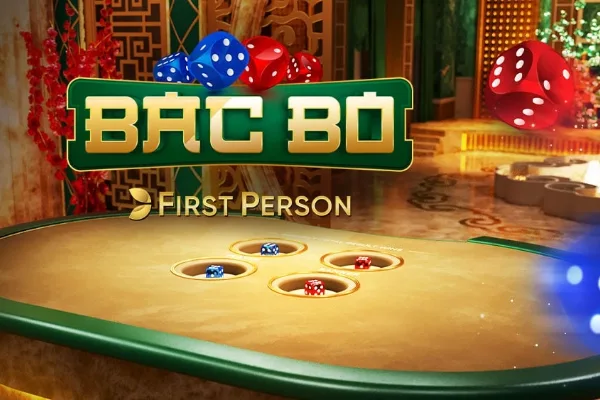
- Environment. First Person uses a 3D table designed to echo the live studio, with an Asian-inspired visual style. There is no host.
- The GO LIVE button. Evolution includes a button that moves you from the First Person table to the live Bac Bo game, so the two act as linked versions of one product.
- Same rules and pays. The three bets, the 10% tie deduction and the 4 to 1 to 88 to 1 Tie ladder are the same structure in both.
First Person Bac Bo is also widely reported to have none of the multipliers used in Evolution's Lightning Bac Bo spin-off, and no side bets. If you want multipliers, that is a different game.
Roads, history and table tools
First Person Bac Bo includes the scorecards familiar from baccarat. Its listed features include the Bead Road, Big Road and the Derived Roads, which record previous results as patterns and keep updating rather than clearing.
These roads are history displays. They show what has happened. Because each roll of four dice is independent, they cannot indicate what will happen next, and no result is ever "due". Other listed tools include Auto Rebet, a bet history panel, a betting window, and mobile and tablet support. The game is commonly described as having no Autoplay function.
Bet sizes vary by site. Stake ranges are set by the operator rather than published as a fixed rule, so we haven't listed them.
Who First Person Bac Bo suits
It suits players who like games they can fully understand. With three bets, two dice per side and a published pay table, every probability in the game fits in one table, as shown above.
It suits anyone who likes the pace of baccarat but wants rounds on demand, especially with the Fast setting.
It suits players who compare return figures closely, since the Player and Banker bets sit at 98.87% and the 1.13% edge can be traced to a single rule, the 10% deduction on ties.
It is less suited to anyone who wants features, bonus rounds or multipliers. There are none, and long sessions can feel repetitive with only three choices. Players chasing the 88x top pay should know it comes from a Tie bet with a clearly lower return.
The case for and against First Person Bac Bo
Pros
- Player and Banker bets return 98.87%, with identical odds for both sides
- Rules are simpler than baccarat: no drawing tableau, no modulo scoring
- Rounds on demand, with Normal and Fast speed settings
- GO LIVE button links straight to the live Bac Bo table
Cons
- The Tie bet returns only 95.52%, and most ties pay just 4 to 1
- No side bets, multipliers or features for variety
- The 10% deduction on ties means Player and Banker bets don't fully push
First Person Bac Bo FAQ
How does First Person Bac Bo work?
Four dice are rolled, two for Player and two for Banker, each in its own shaker. Each hand's total is the sum of its two dice. The higher total wins, and equal totals are a Tie.
What happens to Player and Banker bets on a Tie?
They are not settled as a loss or a full push. The pay table shows 0.9 to 1, meaning 90% of the stake is returned and 10% is lost.
What is the RTP of First Person Bac Bo?
98.87% on the Player and Banker bets and 95.52% on the Tie bet. Both figures can be reproduced by counting the 1,296 possible dice combinations.
What is the max win?
88x, from a Tie bet when both hands total 2 or both total 12. That happens in about 0.15% of rounds.
How often is there a Tie?
In 146 of 1,296 combinations, about 11.27% of rounds. Ties on 6, 7 or 8 are the most common tie results.
Is Player or Banker the better bet?
Neither. Both sides roll identical dice under identical rules and both return 98.87%. Past results on the roads don't affect the next roll.
How is it different from live Bac Bo?
The rules and pays are the same. First Person uses an RNG and a 3D table instead of a studio host and physical shakers, lets you start each round yourself, adds Normal and Fast speed modes, and includes a GO LIVE button to switch to the live game.
When was First Person Bac Bo released?
March 2025, widely dated to 12 March 2025. The live Bac Bo game it is based on was announced by Evolution in January 2022.