If you've played the same slot in different places, you may have noticed some versions have no autoplay button or turbo switch and always take a moment before the next spin. In Great Britain, that is usually down to the Gambling Commission's rules on game design. They are set out in the remote gambling and software technical standards, known as the RTS.
This article covers what the rules say, when they started and how they grew beyond slots. It is based on the Commission's own publications.
The 2021 package for online slots
On 2 February 2021, the Commission announced a package of changes for online slots, with a deadline of 31 October 2021. It said online slots were the gambling product with the highest average losses per player, and that the targeted features were linked to more intense play, loss of control and binge play.
The package covered four areas:
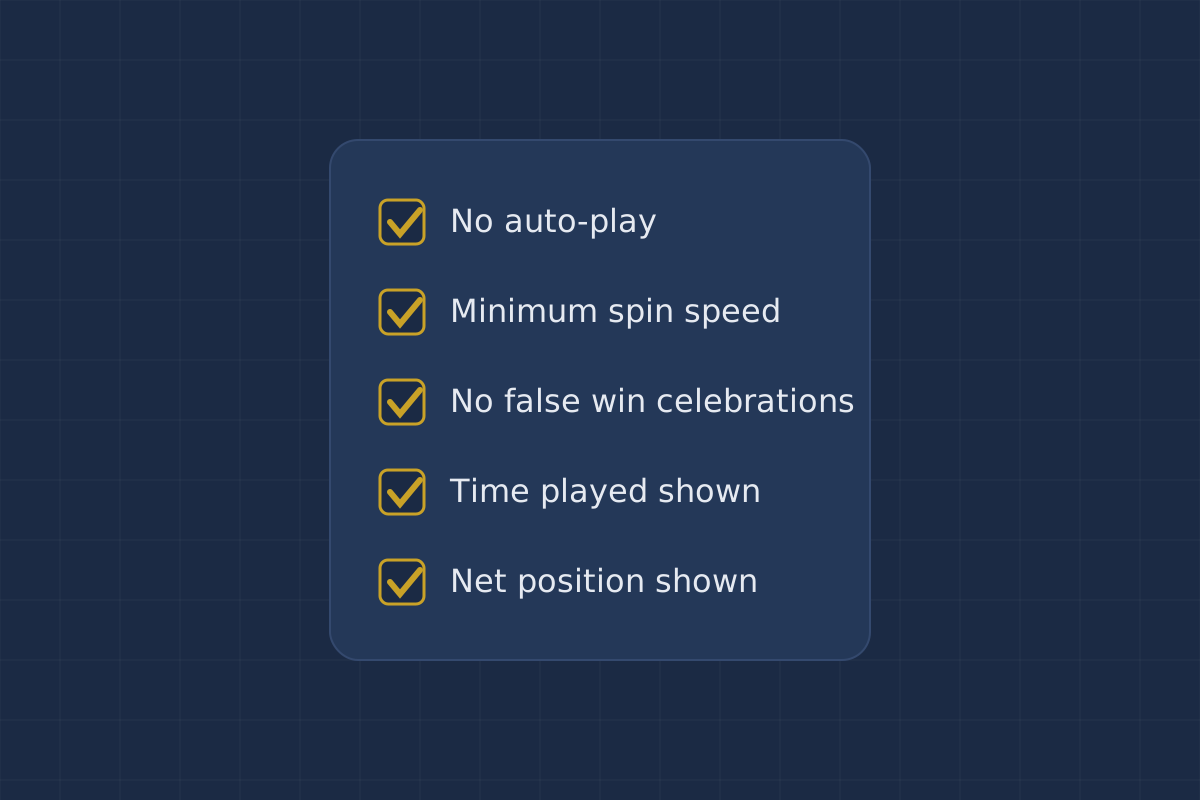
- Speed. Spins faster than 2.5 seconds were banned, along with features that speed up play or give an illusion of control over the outcome.
- Autoplay. Autoplay was removed, citing evidence that it contributed to players losing track of their play.
- False wins. Sounds or images that suggest a win when the return is equal to or below the stake were banned.
- Session information. Players had to be shown their total losses or wins and the time they had spent playing.
What the rules say today
The standards were updated again and now sit under RTS 14, "Responsible product design". The Commission's page for RTS 14 was last updated on 12 January 2026. The parts most relevant to game design are:
- RTS 14C. Casino systems must not offer a way to play several games at once, whether split-screen, multi-screen or combined.
- RTS 14D. Slots must allow at least 2.5 seconds between starting one game cycle and starting the next. The player must release and press the start button again for each cycle. Holding it down can't trigger repeated spins.
- RTS 14E. A casino game must not let the player shorten the time before the result appears. Turbo, quick spin and slam stop are named as not permitted. Bonus or feature games without an extra stake are excluded, as are scratch-all or reveal-all features.
- RTS 14F. A casino game must not celebrate a return that is less than or equal to the total stake. The game can show the amount and play a brief result sound, but no win-style effects.
- RTS 14G. Casino games other than slots must allow at least 5 seconds between game cycles.
A general rule, RTS 14A, applies across all gambling. Products must not encourage customers to chase losses, raise their stake or keep playing after they have said they want to stop.
January 2025: the rules extended beyond slots
On 1 May 2024, the Commission announced several changes with different start dates. The one for remote game design took effect on 17 January 2025. It applied the existing slot restrictions to other online casino products. Turbo and slam stops, autoplay, celebrations of returns at or below the stake, and operator-led functionality for playing several products at once were all banned. The 5-second minimum for non-slot games, set out in RTS 14G, and real-time display of net spend and session length were also part of it.
The Commission's consultation papers set out the display rules. A customer's net position is total winnings minus total losses since the session started. Elapsed time must be shown throughout the session in hours, minutes and seconds.
Stake limits followed in spring 2025
Separately, the government introduced maximum stakes per game cycle for online slots. The Commission's guidance describes two tiers. A limit for all adults came into force on 9 April 2025, and a lower limit for players aged 18 to 24 applied from 21 May 2025. The Commission's guidance gives the exact figures.
What this means for a free-play site
SlotsRanker uses virtual coins only, so these rules don't govern play here in the same way. They're still useful background. They explain why a game's rules screen can differ between regions, and why features mentioned in our reviews, such as autoplay on Plinko+, may be missing in British versions of the same game.
They also match how we write about games. The rule against celebrating returns at or below the stake is the same principle behind our approach to wins: a result is a multiple of the stake, and a return below the stake is not a win. When you open Lucky Pharaoh, Golden Winner or Fishin Frenzy here, you're playing a free version. The rules above describe how stake-based versions of games like these must behave in Britain.
If you want to understand the game loop the rules are designed to slow down, start with how slots work. For practical ways to keep play in check, see playing responsibly.
Sources
- gamblingcommission.gov.uk/news/article/gambling-commission-announces-package-of-changes-whic…
- gamblingcommission.gov.uk/news/article/new-rules-boosting-safety-and-consumer-choice
- gamblingcommission.gov.uk/standards/remote-gambling-and-software-technical-standards/rts-14-…
- gamblingcommission.gov.uk/licensees-and-businesses/guide/online-slots-stake-limit-guidance